

Should I Go To The Hospital After A Car Crash?

Should I Go To The Hospital After A Car Crash?

There are approximately 4 million emergency room visits related to car crashes every year in the United States. The people who visit emergency rooms after a car crash suffer a wide range of injuries from whiplash and other soft tissue injuries to head trauma and spinal cord damage.

Car crash victims should always go to the hospital immediately after a crash if they are in need of emergency medical attention. But, victims with nonlife-threatening injuries should also make it a priority to go to the hospital for medical attention right away. Why? Here are some of the many reasons:

Symptoms Don’t Always Appear Right Away

People often assume that they will be able to tell if they are injured right after the crash occurs. It’s true that victims are usually able to tell that they have sustained an injury after the crash. But, some victims do not notice symptoms of their injuries for hours or even days after a crash.

How does this happen? When the body senses potential danger, it automatically begins to release adrenaline to prepare the body for a fight-or-flight response. Adrenaline blocks the pain receptors, which is why car crash victims often cannot tell their body is in pain immediately after a crash. Once the adrenaline wears off, car crash victims will finally be able to sense their pain again.

Because of the release of adrenaline, what may feel like a minor injury at the scene of the crash could actually be a major injury. For this reason, it’s best to seek medical attention so a doctor can examine the injury. Car crash victims that wait to see a doctor may find that the injury has become much worse by the time their adrenaline rush has gone away and they are able to feel pain. If the injury has worsened, it may be harder to treat.

Delayed Medical Treatment Could Affect Your Personal Injury Claim

Seeking medical treatment as soon as possible after a car crash is also important if you plan on filing a personal injury claim. The at-fault party’s insurance company is responsible for compensating you for the injuries sustained in the crash. However, no insurance company will write a check to a car crash victim without first reviewing the victim’s medical records.

Besides determining if the injuries actually exist, the insurance adjuster will also look at the dates that you were treated. If you waited to see a doctor after a crash instead of going to the hospital right away, this will be a huge red flag for the insurance adjuster.

The insurance adjuster’s goal is to settle the case for as little as possible. Delayed medical treatment can help insurance adjusters accomplish this goal. The insurance adjuster may argue that the injuries are not as serious as you are claiming because if they were, you would have went to a doctor right away. Insurance adjusters can also argue that there’s no way to prove that the injuries were sustained in the car crash since you didn’t seek medical attention immediately after the crash. These arguments are not always effective, but if they are, they could significantly limit the amount of compensation that you are able to recover.

To prevent these problems, visit a hospital as soon as possible after a crash so a doctor can document when the injuries occurred and their severity.

Hospitals Offer Better Care Than Walk-In Clinics or Chiropractors

Car crash victims often think that it’s a good idea to go to a chiropractor or walk-in clinic after a crash, but that’s not necessarily true. Hospitals are known for having the best doctors in the community, so the medical care offered at these facilities will be of a higher quality than the care offered at a walk-in clinic.

Chiropractors specialize in injuries that affect the musculoskeletal system, which includes the muscles, ligaments and joints. These healthcare providers are not trained to handle injuries that affect other areas of the body, which is why you should visit a hospital instead of a chiropractor’s office. A chiropractor will not be able to examine car crash victims to look for and diagnose other injuries. They will also not be able to provide a wide range of treatments that car crash victims often need after being involved in a crash.

Plus, insurance companies often place lower values on personal injury cases involving victims that sought chiropractic care after a crash. This is because insurance adjusters favor traditional treatments provided by hospitals and physicians over specialized chiropractor care. Therefore, it’s possible that visiting a chiropractor over the hospital could lower the value of your car crash claim.

Visiting the Hospital: Yes or No?

The answer to this question is “it depends.” Car crash victims should only go to the hospital if they believe they are injured—regardless of how minor the injury may seem. However, car crash victims who are certain that they did not hit their head against anything, jerk their head back and forth, or sustain an injury in any other way do not have to go the hospital. If the events of the crash are a blur, it may be hard to remember whether or not you could have hit your head or been thrown forward hard enough to cause whiplash. In this situation, it’s better to be safe than sorry. Whenever you are in doubt about whether or not you are injured, it’s in your best interests to seek medical treatment.

Have you been injured in a car crash? Seeking medical attention should be your first priority. Then, contact Trial Lawyers for Justice today to schedule a consultation regarding your case. Let our experienced team of personal injury attorneys fight for the compensation that you deserve.
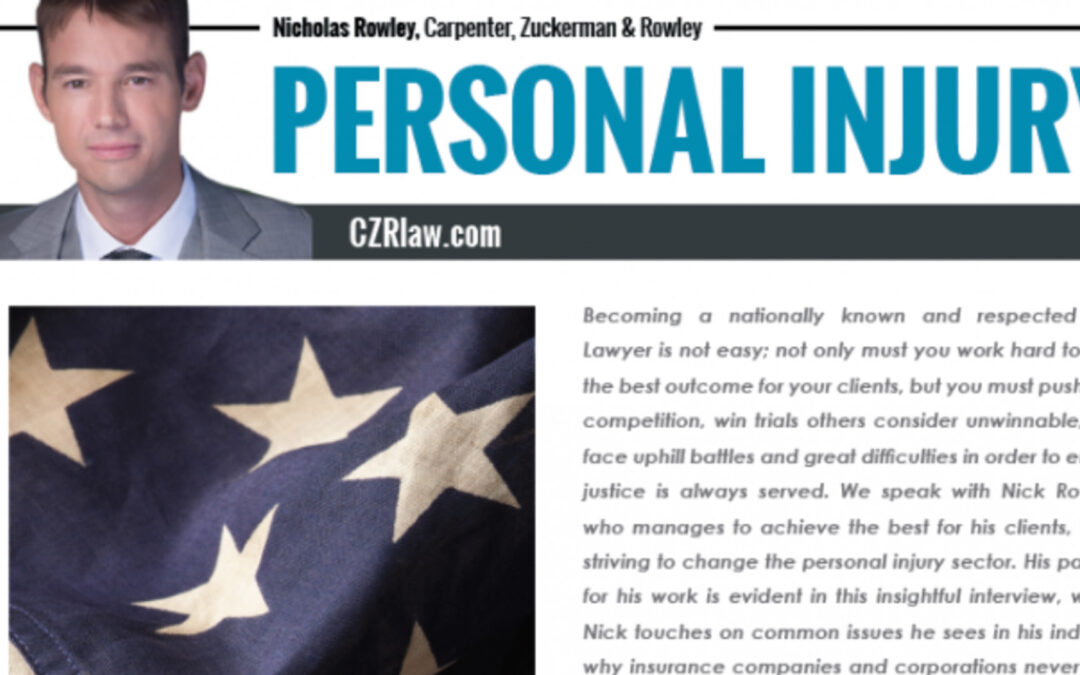
Nick Rowley Featured As Thought Leader In Lawyer Monthly

Nick Rowley Featured As Thought Leader In Lawyer Monthly

Nick Rowley, founder of T rial Lawyers for Justice and partner at Carpenter, Zuckerman, & Rowley, was featured as a thought leader in the personal injury section of the latest edition of Lawyer Monthly.

In the article, Rowley talks about how he fights for his clients and gets to know them on a personal level.  Rowley stated “when he is representing an injured human being, the only thing on his mind is fighting for them to get the justice they deserve.  I live, breathe, and dream about the case I am handling.”

The full interview and article can be viewed in PDF form online by clicking here.

If I Am Partially At Fault For A Personal Injury, Can I Still File A Lawsuit?

If I Am Partially At Fault For A Personal Injury, Can I Still File A Lawsuit?

Anyone who is injured by the negligent acts of another person has the right to file a personal injury claim. The purpose of a personal injury claim is to hold the at-fault party accountable for their negligent behavior and demand that they compensate you for the injuries they have caused.

But in many cases, more than one party may be partially to blame for the incident. Sometimes, one of these negligent parties is the person who is filing the personal injury claim. What happens if you are partially to blame for your own injuries? Can you still file a lawsuit? Here’s what you need to know:

The Role of Negligence in Personal Injury Cases

It’s important to understand how negligence plays a role in personal injury cases before learning about whether or not you can recover compensation if you are partially to blame for the incident.

In every personal injury case, it is the plaintiff’s responsibility to prove that the defendant’s negligent behavior directly caused the plaintiff’s injuries. To do this, the plaintiff must prove the following:

  • The defendant owed a duty of care to the plaintiff
  • The duty of care was breached
  • The plaintiff was injured as a result of the breach of duty of care

A “duty of care” is a legal term that refers to a person’s obligation to act in a responsible manner in order to avoid hurting others. For example, a driver owes a duty of care to all other drivers on the road. Drivers must act responsibly because if they don’t, their actions could harm other drivers on the road.

Breaching a duty of care is the definition of negligence. A duty of care is breached when a person fails to fulfill this legal obligation to act reasonably and responsibly. Using the same example from above, drivers can breach a duty of care when they choose to get behind the wheel while under the influence of alcohol. Driving drunk is not reasonable or responsible, so the driver is breaching the duty of care they owe to other drivers. Of course, this is only one example of how someone can breach their duty of care to others.

If the breach of the duty of care results in injuries, the victim has the right to sue. This means if a drunk driver hurts someone by colliding into their vehicle, they have the right to file a personal injury lawsuit against the drunk driver.

If the plaintiff can prove these three elements of negligence, they can prove the defendant was liable for the occurence and recover compensation for their injuries.

Modified Comparative Negligence Laws in Iowa

Sometimes, the plaintiff’s negligence can contribute to the cause of the incident as well. For example, let’s say you are jaywalking across the street when a vehicle hits you. The driver of the vehicle was texting at the time, which is why they did not see you in front of them. Texting while driving is dangerous, so the driver of the car that hit you is partially to blame for the crash. But, you are also partly to blame. Jaywalking is illegal and dangerous, so engaging in this activity is negligent. If you had walked across the street at a crosswalk, the incident may not have happened. In this case, both parties’ negligence led to the event.

Iowa has modified comparative negligence laws that come into play when the plaintiff is partially responsible for the occurrence that caused their injuries. The law states that a plaintiff can still recover compensation from the defendant as long as the plaintiff is not more than 50% liable for the incident. However, the amount of compensation that is awarded to the plaintiff will be reduced to account for the role that they played.

To illustrate how these laws work, let’s say you file a personal injury lawsuit against another driver who crashed into your car. The jury finds that both you and the defendant were negligent, and therefore both of you are partially responsible for the event. They believe that the defendant was 70% responsible for it and you were 30% responsible. As a result, the compensation that is awarded to you will be reduced by 30%.

As previously mentioned, the law bars plaintiffs who are more than 50% responsible for the incident from recovering compensation. This means if the jury found that you were 51% responsible and the defendant was only 49% responsible, you would not be awarded any compensation for your injuries.

How to Determine If You Are Partially to Blame

Determining who is liable for an incident is one of the most difficult steps in a personal injury case. It involves conducting a thorough investigation to gather evidence that shows which party caused the event. Evidence can be obtained by interviewing witnesses, reviewing surveillance footage, examining photos of the scene of the incident, and working with a reconstruction expert. Conducting this type of investigation requires extensive resources, which is why it’s best to let a personal injury attorney help. An attorney will be able to gather the evidence that you need to prove the other party was to blame. If your negligence played a role, an attorney can fight to ensure that this does not affect your ability to recover compensation.

Have you been injured in an incident that was partially or totally another person’s fault? If so, contact Trial Lawyers for Justice today to schedule a consultation regarding your case. Our experienced personal injury attorneys will help you seek justice against the negligent parties and recover the compensation that you deserve. The sooner that you contact our team about your case, the better the outcome may be.

Farm Equipment Accidents How to Share the Road What You Need to Know

Farm Equipment Accidents How to Share the Road What You Need to Know

Farmers must use a lot of equipment in order to maintain their farms, including trucks, tractors, bailers, choppers, and seeders. Any piece of heavy machinery can be dangerous, regardless of how familiar the farmer is with its use. However, some of the most serious farming equipment accidents involve tractors, trucks, and other equipment that is sometimes driven on the road alongside vehicles. Whether you are driving next to someone operating farming equipment or you are the one operating it, it’s important to learn how to share the road and stay safe. Here’s what you should know:

Types of Farm Equipment Accidents

There are many different types of farm equipment accidents that can happen on the road. First, a vehicle can collide with farm equipment when attempting to pass the farmer or by rear-ending the farm equipment. These accidents can be just as serious if not more serious than standard traffic accidents involving two or more cars.

Another common type of farm equipment accident is a tractor rollover. This type of accident can occur anywhere, but it is most common when the tractor is turning, driving near steep slopes, or driving near the edge of the road. A rollover can also occur when the farmer is shifting gears or slamming on the brakes‚ especially if the roads are slippery due to rain. Newer tractor models are supposed to have rollover protection systems (ROPS) that prevent rollover accidents. Although older tractors are more likely to rollover than newer ones, it’s still possible to rollover in a newer model that has ROPS.

Injuries and fatalities can also occur when something flies off of the farm equipment and hits a pedestrian, bicyclist, or vehicle nearby. This may not seem as dangerous as colliding directly with farm equipment, but it can be depending on the type of object and where it lands.

Sharing the Road With Farm Equipment

It’s important to drive carefully at all times, especially when you are around farm equipment. Farm equipment does not travel as fast as vehicles, so you may want to pass the farmer so you don’t get stuck traveling at a slow pace. But, do not pass farm equipment unless you can clearly see the road ahead so you can be certain that there is no oncoming traffic. You should also leave plenty of room to the side of your vehicle for the farm equipment, since many types of equipment are actually wider than they appear to be from behind.

It can be frustrating to get stuck behind farm equipment, but try to remain patient. Do not tailgate the farm equipment in an effort to make the farmer go faster. Not only is this not an effective way to tell someone to go faster, but it could also lead to serious injuries if you accidentally rear-end the equipment.

It’s also important to recognize when a farmer is trying to turn left. Farm equipment is difficult to maneuver, so farmers need to make wide left turns to prevent rollovers. To do this, they need to pull to the right side of the road. Other drivers often interpret this as the farmer being nice and allowing the driver to pass, but that’s not the farmer’s intention. If a driver speeds up to get around the farmer right as they are completing the left turn, this could lead to serious injuries. To prevent this from happening, make sure you never make assumptions about what where farm equipment is going. Be cautious and wait for the farmer to signal that you can pass instead of trying to guess what their next move will be.

Drivers should also know that it can be difficult for a farmer to hear anything over the noise of the equipment. Therefore, no one should ever assume that it is safe to pass farm equipment as long as the farmer is warned with a few beeps of the car horn. Farmers have to stay so focused on the road ahead that they may not even see your vehicle as it starts to approach them from the side.

Farmers should do their part to keep the roads safe, too. To avoid accidents, farmers should always turn on their lights when driving at night. They should also put reflective tape and reflectors on the equipment to ensure they are visible to other people on the road. If a farmer spots another driver approaching from behind, the farmer should make an effort to pull off to the side of the road and allow the driver to pass. However, there’s no rush to do this, so wait until you have found a safe place to pull off to the side of the road.

Liability For Farm Equipment Accidents

If you have been injured in an accident with farm equipment, you may be able to recover compensation for your medical expenses, lost wages, and pain and suffering. But first, you must be able to prove that the operator of the farm equipment was to blame for the accident. An attorney can assist with this step in the process by analyzing photos from the scene of the accident, conducting interviews with witnesses, and reviewing medical records.

The operator of the equipment is not the only one who could be held liable. Some accidents are caused by a defective or malfunctioning part of the equipment. In this case, the operator of the equipment cannot be held liable since the defect is not their fault. Instead, the manufacturer of the equipment could be responsible for any injuries that occurred.

Have you been injured in an accident with farming equipment? If so, contact Trial Lawyers for Justice today to schedule a consultation regarding your case. Our skilled personal injury attorneys will immediately get to work to determine who was at fault for the accident so we can start fighting for the compensation that you deserve.

Nick Rowley Interviewed About The Destiny Reyes Case

Nick Rowley Interviewed About The Destiny Reyes Case

Nick Rowley was recently interviewed by DK Global regarding the Destiny Reyes case.  Listen along to the full podcast at the link below to learn more about the case, how Nick prepares for a case, and the tools he uses in conveying complex medical conditions to a jury.